
The Iran War Charlotte housing impact is reshaping the spring 2026 market in ways most people didn’t see coming. Here’s what buyers and sellers need to know.
Key Takeaways
- Mortgage rates jumped from 5.98% in late February to 6.30% by late April after the Iran conflict began, with daily trackers briefly showing rates in the mid-6s on April 29
- Plan around 6% or higher rates for the rest of 2026; the Fed can’t cut rates while inflation is elevated
- Many lenders are reporting that average applicant FICO scores have dropped by a few dozen points since late February due to rising credit card balances from inflation
- Charlotte’s market is holding up better than national averages thanks to strong job growth and 54,000+ new residents in the past year
- Sellers who price to current buyer affordability are selling within 30-45 days; those pricing to 2022 conditions are sitting
- Buyers have more leverage than they’ve had in years, with rate buydowns and concessions increasingly common
Three months ago, the conversation in our office was about how 2026 was finally going to be the year. Rates had dipped below 6 percent for the first time in four years. Inventory was building. Buyers who’d been waiting since 2022 were ready to move. Sellers locked in at sub-5 percent rates were starting to consider listing again.
Then Iran happened, and the math changed.
I want to walk through what’s actually shifted, why it matters for anyone making a real estate decision in Charlotte right now, and what the smart moves look like in this environment. There’s a lot of noise in the headlines, so let’s focus on what’s measurable and what you can do about it.
How Oil in the Middle East Becomes a Higher Mortgage Payment in Cornelius
The connection between a Middle East conflict and your monthly housing costs isn’t obvious until you trace it. Here’s the short version of how this works.
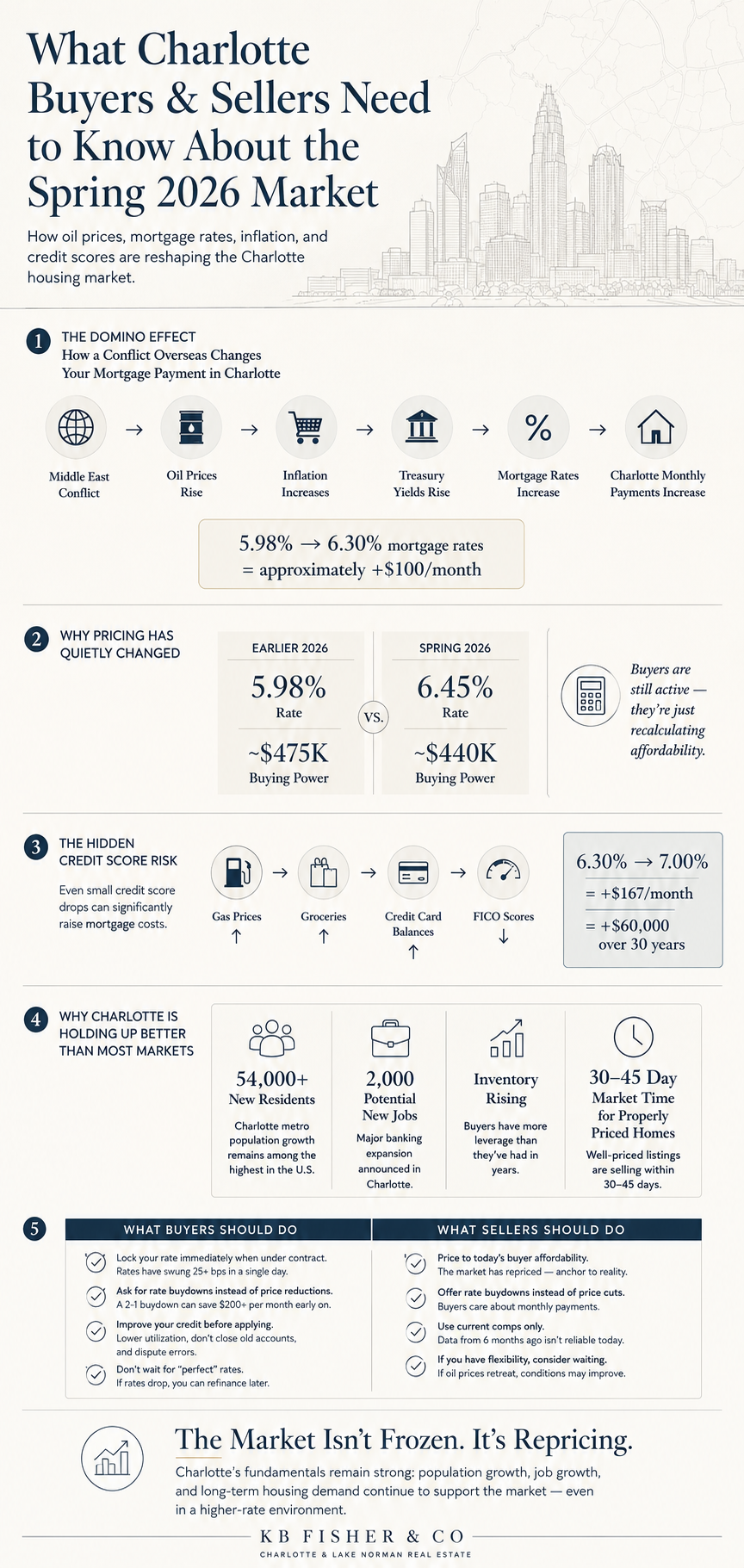
When oil supply gets disrupted, prices spike. Brent crude went from the low 70s per barrel before the conflict to the low 110s by late April, a roughly 50 to 60 percent jump in a matter of weeks. Higher oil costs feed into transportation, manufacturing, and consumer goods, which pushes inflation higher. When inflation rises, bond investors demand higher returns to hold long-term Treasury debt. The 10-year Treasury yield climbed from just under 4 percent in late February to around 4.4 percent by late March.
Mortgage rates track the 10-year yield closely. So when that yield jumps, mortgage rates follow. Freddie Mac’s 30-year fixed rate averaged 5.98 percent in late February and 6.30 percent by the end of April, and several daily rate trackers briefly showed 30-year rates in the mid-6s around April 29.
That sequence took about eight weeks, start to finish.
For a buyer financing $360,000—roughly the loan amount on a Charlotte median-priced home with 10 percent down—the difference between 5.98 percent and 6.30 percent works out to roughly $100 more per month, or about $39,000 in additional interest over the life of the loan. That’s the cost of the war showing up on a Charlotte family’s mortgage statement.
Why the Federal Reserve Can’t Fix This Quickly
A common question I’m getting is some version of “won’t the Fed just cut rates and bring mortgages back down?”
The answer is no, at least not right now. The Fed is in a corner. Inflation is running closer to 3 percent than the 2 percent target. Recession risk is around 30 percent based on recent forecasts. Unemployment is projected to climb toward 4.5 percent by year-end. Cutting rates while inflation is elevated would make the inflation problem worse. Holding rates steady or raising them would slow an already softening economy.
The takeaway: plan around 6 percent or higher rates for the rest of 2026. If oil prices retreat or the conflict de-escalates, that calculation could change. Until then, anyone making a housing decision should run the numbers based on current rates, not on the assumption that rates are about to drop.
The Credit Score Problem Nobody’s Talking About
Here’s where the second-order effects of this conflict get more concerning, and where I’d encourage anyone planning to buy in the next 12 months to pay close attention.
Higher gas prices, higher grocery bills, and higher utility costs are eating into household budgets. When budgets get squeezed, families absorb the gap by running up credit card balances. Credit cards carry interest rates around 21 to 22 percent. Once balances climb, minimum payments rise, and utilization ratios climb past the 30 percent threshold that starts dragging down FICO scores.
Many lenders are telling us they’re seeing average applicant scores down by a few dozen points since late February. That’s not a small shift. A borrower at 760 today qualifies for current rates. The same borrower after a meaningful credit drop might face rates 0.3 to 0.7 percent higher, plus higher PMI premiums for anyone putting less than 20 percent down.
On a $360,000 loan, a credit-driven rate increase from 6.30 to 7.00 percent costs roughly $167 more per month, or about $60,000 over 30 years. For some buyers in this market, the credit damage may end up being a bigger factor than the war-driven rate increase itself.
There’s also a debt-to-income angle. Even households that haven’t taken on new debt are watching their non-mortgage DTI ratios climb because of rising minimum payments on existing balances. A family that was at 28 percent DTI in January might be at 33 percent now, and that shift can shrink mortgage approval capacity by $40,000 to $65,000 depending on income.
What’s Actually Happening in the Iran War Charlotte Housing Market
Despite the national headwinds, the Iran war’s impact on the Charlotte housing market has been less severe than national averages suggest. Here’s what we’re seeing locally:
The lock-in effect is finally cracking. According to a recent Coldwell Banker agent survey, 35 percent of current sellers nationally have mortgage rates below 5 percent and are listing anyway. We’re seeing the same thing in Lake Norman. Life events, including job changes, growing families, downsizing, and divorce, don’t stop for interest rates. Homeowners who’ve been waiting since 2022 are deciding to move.
Inventory is at multi-year highs across our service area. That’s good news for buyers and challenging news for sellers who haven’t adjusted to the new pricing reality.
Buyer demand is still there, but it’s pickier. Pending sales nationally are running near their strongest pace since the post-pandemic sugar high cooled off, and Zillow has reported double-digit increases in listing views year-over-year. Buyers are looking. They’re just being more selective about what they’re willing to pay.
The pricing dynamic is the most important shift to understand. A home that would have sold for roughly $475,000 at a 5.98 percent rate is effectively worth around $440,000 at 6.45 percent, because that’s what buyers can actually afford given the higher financing costs. Sellers who price based on what their neighbor sold for in 2022 are watching their listings sit. Sellers who price based on current buyer affordability are getting offers within 30 to 45 days.
Charlotte’s underlying economic fundamentals are also working in our favor. North Carolina is projected to lead the Upper South Atlantic region in 2026 economic growth at 2.6 percent, ahead of the 2.4 percent national average. Sumitomo Mitsui Banking just announced a major Charlotte expansion that could bring up to 2,000 jobs over the next several years. The metro added more than 54,000 residents from mid-2024 to mid-2025, the fifth-highest population gain in the country. None of that is changing because of Iran.
What History Tells Us to Expect
The 1990 Gulf War is the cleanest historical comparison. Oil prices rose roughly 75 percent in two months. Existing home sales fell about 4 percent for the year. Price appreciation stalled. The market didn’t crash. It froze, then thawed when oil prices retreated and the recession ended in 1991.
That’s the most likely playbook for 2026. Unless something dramatic shifts in the conflict, expect a slower-than-normal spring and summer, with conditions improving once oil supply normalizes. The 1979 to 1982 period after the Iranian Revolution is a more cautionary parallel, with mortgage rates eventually peaking around 18.6 percent under Volcker, but we’re not in that scenario right now and I don’t expect we will be.
The pattern across every major Middle East energy shock since 1973 is that the credit damage to consumer balance sheets outlasts the conflict itself. Borrowers who protect their credit profile during the next 18 to 24 months are going to be in a meaningfully better position when conditions normalize.
What Buyers Should Actually Do
Lock your rate immediately when you go under contract. Single-day rate swings of 25 basis points or more have happened multiple times in the past two months. Floating a rate is a high-risk bet right now.
Ask sellers for rate buydowns rather than price reductions. A 2-1 buydown can save a buyer $200 or more per month for the first two years, which is more impactful than a $10,000 price reduction in most cases. Sellers are increasingly willing to fund these.
Reconsider 7/6 ARMs if you plan to move or refinance within seven years. They’re worth running the numbers on, though current spreads have sometimes been narrower than expected, so verify with your lender.
Get your credit in shape before applying. Bring credit card utilization below 10 percent. Don’t close old accounts, even unused ones. Pull all three credit reports and dispute errors. These moves can yield 30 to 50 FICO points within 60 days, which translates directly into better rate tiers.
Don’t wait for rates to fall back below 6 percent. They might. They might not. The window in February was about five minutes long. Buyers who buy now with realistic expectations can refinance later if rates drop. Buyers who wait might find themselves competing with everyone else who waited.
What Sellers Should Actually Do
Price to current buyer affordability, not to what your neighbor got in 2022. The market has repriced whether sellers acknowledge it or not. Homes that linger on the market through spring tend to sell for less in summer. The fastest movers in our area in the past 60 days have been sellers who got the pricing right from day one.
Consider offering rate buydowns instead of price reductions. A $10,000 buydown often beats a $20,000 price cut in terms of what actually moves a home. Buyers care about monthly payment, and buydowns deliver more monthly savings per dollar than price reductions.
Get a current market analysis before listing. The comps from six months ago aren’t reliable indicators of where your home should be priced today. Work with someone who tracks the data weekly and understands how Charlotte’s submarkets are performing differently right now.
If you’re not in a hurry, consider waiting until oil prices retreat. If you have flexibility, holding off until conditions normalize might yield a better outcome. That’s a personal decision that depends on your specific situation.
The Bigger Picture
The Iran war’s reshaping of the Charlotte housing market is real, but it’s not catastrophic. Buyers and sellers who succeed in this environment are the ones who understand current data, set realistic expectations, and make decisions based on what’s actually happening rather than what they hoped would happen.
NAR came into 2026 calling for mid-teens sales growth. They’ve already cut that back to the low single digits. But Charlotte continues to function. Population growth, job growth, and constrained supply are real, durable advantages that will keep our market moving even when national conditions stay choppy.
The question isn’t whether you should buy or sell in this market. The question is whether your strategy fits the market that actually exists right now. That’s the conversation worth having.
Want to Go Deeper?
If you want to understand what NAR’s Deputy Chief Economist was predicting for spring 2026 before the Iran conflict reshaped the forecast, I covered that here: NAR’s Deputy Chief Economist on Spring 2026 Housing Market: What to Expect in the Next 90 Days
For a broader look at what leading housing economists were forecasting for 2026 as a whole and how those predictions are holding up: 2026 Housing Market Forecast: What Leading Economists Are Predicting for Charlotte
And if you want to see the most recent Charlotte market data, the Charlotte Housing Market May 2026 Update: What You Need to Know
If you’re thinking about buying or selling this spring and want to talk through timing, pricing, or strategy in this changing rate environment, our team is always happy to walk through it with you. Click here to get started!
Ready to see what’s available?
Search Homes