
The Charlotte housing market May 2026 update brings a surprise that runs counter to most national headlines. The official Canopy MLS April report won’t release until later this month, but here’s what I’m seeing in our local data right now: pending sales in the Charlotte region jumped 17 percent year-over-year. After the Iran conflict pushed mortgage rates from below 6 percent to 6.30 percent in late February and March, the expectation was that buyers would pull back. Instead, they showed up.
The full picture is more nuanced than that single data point. Homes are taking longer to sell. Sellers are getting slightly less of their asking price. Inventory is climbing. But the overall message from April is that Charlotte’s spring market is functioning, and buyers who’d been waiting are finally moving.
At a Glance: April 2026 Charlotte Region
- New Listings: 7,052 (up 8.3% from 6,514 in April 2025)
- Pending Sales: 5,122 (up 17.0% from 4,376)
- Closed Sales: 3,981 (down 1.8% from 4,052)
- Inventory: 14,291 homes (up 8.8% from 13,139)
- Months Supply: 3.7 months (up from 3.5)
- Days on Market (Avg): 58 days (up 20.8% from 48)
- List to Close (Avg): 103 days (up 9.6% from 94)
- % of Original List Price: 97.2% (down from 97.8%)
- Median Sales Price: $385,643 (up 0.2% from $385,000)
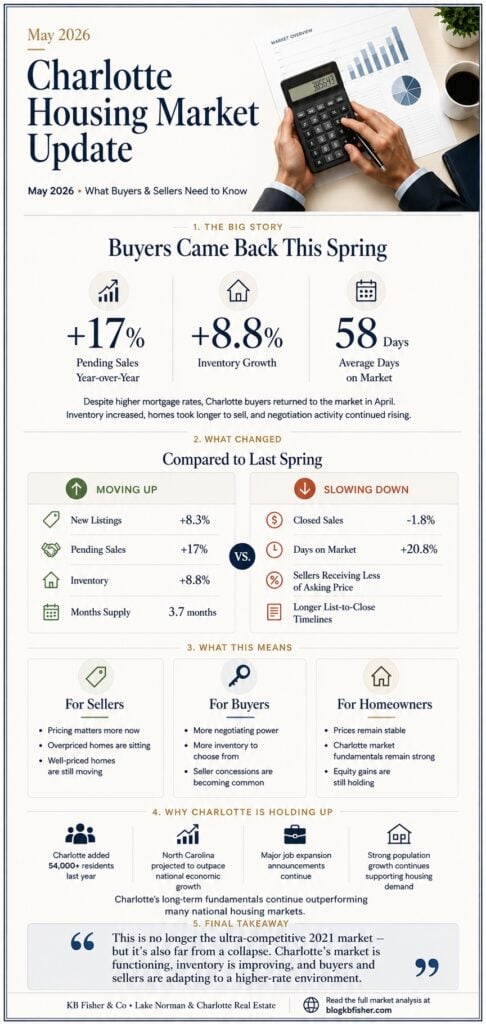
Charlotte Housing Market May 2026: What the Numbers Tell Us
The pending sales jump is the headline. A 17 percent year-over-year increase in pending contracts means buyers got off the sidelines in April. That’s significant given the rate environment we were in. Mortgage rates jumped from 5.98 percent in late February to 6.30 percent by late April, with daily trackers briefly showing rates in the mid-6s on April 29. Buyers had every reason to wait, and they didn’t.
Closed sales told a quieter story, dropping just 1.8 percent year-over-year. Most of those closings reflect deals put together in February or March, before the rate spike fully landed. The pending data is what to watch going forward, because those are the contracts being signed in today’s rate environment.
Days on market climbed to 58 days, up nearly 21 percent from 48 days last April. Homes are still selling, but they’re taking longer. List-to-close timelines stretched to 103 days. This is a different market than 2021-2022, when well-priced homes were selling in two weekends. Buyers are doing more due diligence, taking more time, and being more selective about what they’re willing to pay.
The percent of original list price received dropped to 97.2 percent, down from 97.8 percent last April. Sellers are negotiating more than they were a year ago. Combined with the longer days on market, the message is clear: pricing matters more than it has in years.
Median sales price held essentially flat at $385,643, up just 0.2 percent year-over-year. This is exactly the repricing dynamic we covered in last week’s analysis on how the Iran war is reshaping the market. Higher rates mean buyers can afford less, which means prices either flatten or sellers wait longer for the right buyer.
Why Charlotte Is Holding Up
Despite the national headwinds, Charlotte’s market is performing better than most. National existing-home sales fell 3.6 percent month-over-month in March according to NAR, and the Northeast saw the sharpest declines at 8.5 percent. Charlotte’s pending sales going up 17 percent year-over-year tells a different story.
The fundamentals matter. North Carolina is projected to lead the Upper South Atlantic region in 2026 economic growth at 2.6 percent, ahead of the 2.4 percent national average. Sumitomo Mitsui Banking just announced a major Charlotte expansion that could bring up to 2,000 jobs over the next several years. The Charlotte metro added more than 54,000 residents from mid-2024 to mid-2025, the fifth-highest population gain in the country.
Population growth, job growth, and constrained housing supply are real, durable advantages that keep our market moving even when national conditions stay choppy. April’s data confirmed it.
What This Means for Homeowners
Your equity isn’t going anywhere. Charlotte’s median sales price is up 0.2 percent year-over-year, and over the past six years, the typical homeowner has accumulated roughly $128,100 in housing wealth according to NAR. Even in a slower market, home values are holding.
If you’ve been on the fence about a refinance, watch the rate environment closely over the next 60 days. Rates have been volatile, with single-day swings of 25 basis points or more. There may be windows where rates dip enough to make a refinance worthwhile, but those windows can close fast.
The lock-in effect is finally cracking. Coldwell Banker’s recent agent survey found that 35 percent of current sellers nationally have rates below 5 percent and are listing anyway. Life events don’t stop for interest rates. If you’ve been waiting for a perfect moment to move, the moment may not come, but the market is more functional than it’s been in years.
What This Means for Sellers
The repricing is happening whether sellers acknowledge it or not. April’s data showed homes taking 21 percent longer to sell than last year, with sellers receiving less of their asking price. Pricing matters more now than it has in years.
Homes that are priced to current buyer affordability are still selling within reasonable timeframes. Homes priced to 2022 conditions are sitting, then reducing, then sitting some more. The fastest-moving sellers in our area over the past 60 days are the ones who got the price right from day one.
Consider offering rate buydowns instead of price reductions. A $10,000 buydown often beats a $20,000 price cut in terms of what actually moves a home. Buyers care about monthly payment, and buydowns deliver more monthly savings per dollar than price reductions.
If you’re listing this spring or early summer, get a current market analysis before settling on a price. Comps from six months ago are not reliable indicators of where your home should be priced today.
What This Means for Buyers
The pending sales jump in April tells you something important: other buyers are finding deals. You have more leverage than you’ve had in years. Inventory is up 8.8 percent. Sellers are negotiating. Concessions like rate buydowns, repair credits, and closing cost contributions are increasingly common.
A few practical moves:
Lock your rate immediately when you go under contract. Daily rate swings of 25 basis points or more have happened multiple times since late February. Floating a rate is a high-risk bet right now.
Ask sellers for rate buydowns rather than price reductions. A 2-1 buydown can save a buyer $200 or more per month for the first two years, which is meaningful breathing room.
Get your credit profile in shape before applying. Rising credit card balances from inflation have caused FICO scores to drop a few dozen points across applicants nationally. Bringing utilization below 10 percent can yield 30 to 50 points within 60 days, which translates directly into better rate tiers.
Don’t wait for rates to fall back below 6 percent. They might. They might not. The window in February was about five minutes long. Buyers who buy now with realistic expectations can refinance later if rates drop.
Looking Ahead
The Charlotte housing market April 2026 data suggests our spring market is more durable than national headlines would have you believe. Pending sales are accelerating. Inventory is climbing. Prices are stable. Homes are selling, just at a slower pace and with more negotiation than in recent years.
Whether the rate environment improves over the summer depends largely on what happens with oil prices and the Iran conflict. For now, the smart approach is to plan around 6 percent or higher rates and make decisions based on current conditions, not on the assumption that rates will drop soon.
If you want a deeper dive into how the Iran war is reshaping the broader market and what to watch over the next few months, I covered that in detail here: How the Iran War Is Reshaping Charlotte Housing.
Want to Go Deeper?
If you want to understand what NAR’s Deputy Chief Economist was predicting for spring 2026 before the Iran conflict reshaped the forecast, I covered that here: NAR’s Deputy Chief Economist on Spring 2026 Housing Market: What to Expect in the Next 90 Days
And if you want to see the most recent monthly data before this update, the March 2026 Market Update is here.
If you’re thinking about buying or selling this spring and want to talk through timing, pricing, or strategy in this changing rate environment, our team is always happy to walk through it with you. Click here to get started!
Ready to see what’s available?
Search Homes