
The 2026 housing market forecast from leading economists points to a rebalancing year ahead. Yesterday, I wrote about The Charlotte Metro Housing Market is Shifting Again- and This Time, It’s a Healthier Kind of Change why the last few years felt so artificial. This post digs into what NAR Chief Economist Lawrence Yun and other economists are predicting and what it means for Charlotte and Lake Norman.
I’ve spent the last few weeks listening to economic forecasts, reading reports from the National Association of REALTORS® (NAR), the National Association of Home Builders (NAHB), and realtor.com, and cross-referencing what they’re projecting with what we’re actually seeing on the ground here in Charlotte and Lake Norman.
Here’s what the people who study housing markets for a living are watching in 2026 and what it means for anyone thinking about buying or selling this year.
What Leading Housing Economists Are Forecasting for 2026
The consensus among top housing economists is clear: 2026 is looking more balanced, more predictable, and more functional than the last few years. Not because the market is crashing (it’s not) but because the conditions that made 2021-2023 so chaotic are finally normalizing.
Home Sales Are Expected to Rebound
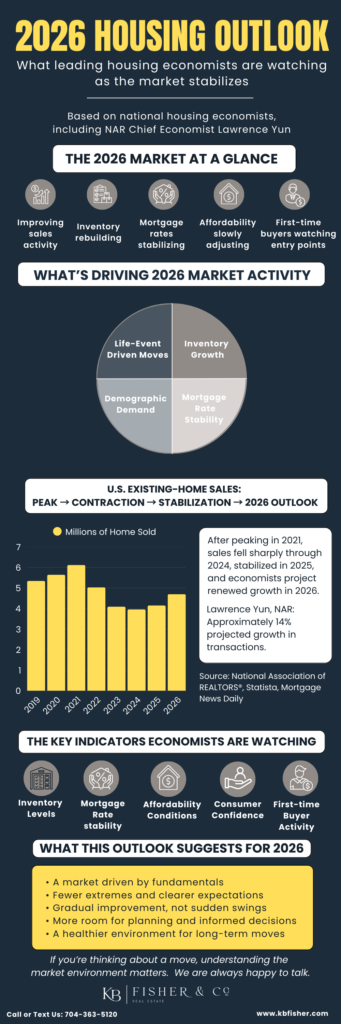
Lawrence Yun, NAR’s Chief Economist, is projecting home sales to increase by about 14% nationwide in 2026. That’s significant. After years of stagnant transaction volume, the market is finally starting to move again.
Why? Two big factors: more inventory and falling mortgage rates. The “lock-in effect” made homeowners with sub-4% rates feel trapped in their current homes and now that is starting to disappear. Life-changing events (think marriage, babies, and job relocations) are pushing more people to list their properties and move on to their next chapter.
We’re seeing that shift locally, too. In December 2025, closed sales in the Charlotte region were up 3% compared to the previous year. It’s not a surge, but it’s steady growth and that’s exactly what a healthy market looks like.
Inventory Is Rising, But We’re Not Oversupplied
One of the biggest changes from the artificial market years is the number of housing inventory. Inventory levels are about 20% higher than they were a year ago nationally, according to Yun. We’re not back to pre-COVID inventory yet, but we’re moving in that direction.
Here in Charlotte, inventory is up 15.8% year-over-year, with 9,985 homes available in December 2025. That’s still a supply-constrained market—2.8 months of supply—but it’s a dramatic improvement from where we were. Buyers have more choices. Sellers have to think about pricing and presentation again. It’s not the frenzy anymore.
Robert Dietz, chief economist at the National Association of Homebuilders points out that while inventory is improving, there’s still a structural housing deficit nationwide. The housing stock isn’t large enough given the size of the population. The only way to solve the affordability challenge long-term is to build our way out of it and that requires zoning reform, more efficient construction, and medium-density development. Mark Rubenstein, is our land specialist and works with many of Charlotte’s largest builders. Mark knows how zoning, pricing and timing factor into the decision making for local builders and how this affects the supply of new home construction. We’ll have a future blog sharing his perspective.
Home Prices Will Grow Modestly—Not Explosively
Home prices aren’t declining, but they’re not skyrocketing either. NAR expects home price growth of roughly 2-3% in 2026—about the same as overall consumer price inflation. That’s a welcome shift. It means wage growth will outpace home price growth for the first time in years, giving people more purchasing power.
Locally, we’re tracking closely with that forecast. The median sales price in Charlotte hit $400,000 in December 2025, up 3.9% from the previous year. Prices are still rising, but at a much more sustainable pace than the 15-20% annual jumps we saw during the artificial years.
Danielle Hale, chief economist at realtor.com, expects this will be the first time since 2020 that monthly payments actually decline. Lower mortgage rates combined with modest price growth mean affordability is improving—not dramatically, but measurably.
Days on Market Are Returning to Normal
Remember when homes were selling in 18-21 days? That pace was unsustainable. It didn’t give buyers time to think, inspect, or negotiate. In 2026, we’re returning to a more functional timeline.
Nationally, days on market are settling back into the 30-40 day range—similar to 2019. In Charlotte, we’re seeing 60 days on average as of December 2025. That’s up 20% from the previous year, and it’s a good thing. It means buyers can breathe. It means sellers have to be strategic. It means decisions are being made with information instead of adrenaline.
Mortgage Rates: The Biggest Unlock for 2026
If there’s one variable that will determine how active the housing market is in 2026, it’s mortgage rates.
Nadia Evangelou, senior economist at NAR, breaks down the math: a one percentage-point drop in mortgage rates can expand the pool of households who can qualify to buy by about 5.5 million households nationwide—including 1.6 million renters who could become first-time buyers.
Not all of those households will buy, of course. But historically, about 10% do. That could translate into roughly 500,000 additional home sales in 2026. That’s the main reason NAR expects transaction volume to increase this year.
Brian Buffini, founder of Buffini & Company, has been emphasizing this point in his market forecasts: mortgage rates don’t need to drop to 3% for the market to function. They just need to come down from 7% to something closer to 6%. That unlocks demand without creating another frenzy. Rates as I write this today are 6.05%. If you’d like to be set up on a rate alert, let us know and we can get that set up for you!
The key, Buffini says, is recognizing that we’re returning to the rhythm of 2019—not 2021. The artificial market is over. What we’re moving into is a functional market with time, choice, and negotiation built back into the process.
Who’s Driving the Market in 2026?
The demographic composition of buyers is shifting in interesting ways.
Jessica Lautz, NAR’s deputy chief economist, is watching two trends closely: the share of first-time home buyers and the continued dominance of all-cash buyers—particularly baby boomers.
Baby Boomers Remain the Dominant Force
Baby boomers have significant housing wealth, and they’re using it to make moves. They’re trading homes to be closer to grandkids, relocating for retirement, and downsizing and sometimes and can do this without needing a mortgage. They’re not making concessions on their home choices because they have the funds to be selective.
All-cash buyers made up a significant portion of transactions in 2025, and Lautz doesn’t expect that to change anytime soon. The wealth in the housing market is real, and homeowners who built equity over the last decade are leveraging it.
First-Time Buyers Are Gradually Re-Emerging
With more inventory and slightly improved affordability, first-time buyers have an opportunity in 2026. Mortgage applications have been trending up for a few months, signaling that buyers who aren’t paying cash are starting to enter the market again.
Lautz emphasizes that we need first-time buyers to come back for the market to function in a healthy way. Homeownership is still a wealth-building tool, and when first-time buyers are priced out or locked out by competition, the entire market stalls.
Single Women Are a Growing Force
Another trend worth noting: single female buyers are growing as a segment of the market. This reflects broader demographic shifts—lower marriage rates, lower birth rates, and more women prioritizing financial independence and homeownership on their own terms.
Just a quarter of buyers have kids in the home anymore, according to NAR data. Household sizes are shrinking. Home sizes are shrinking. The typical buyer profile is evolving, and the market is adjusting to meet that.
Regional Differences Are Becoming More Pronounced
One thing the economists all agree on: national averages only tell part of the story. Regional variation is significant.
Danielle Hale notes that in the South and West policies have enabled more construction and housing markets are more in balance. In the Northeast and Midwest, inventory still lags behind pre-pandemic norms, and prices have continued to rise.
Robert Dietz is watching geographic shifts closely. Previously hot markets like Texas and Florida have slowed due to some cyclical overbuilding and persistently elevated mortgage rates. But pockets of strength are emerging in the Midwest. Markets like Columbus, Indianapolis, and Kansas City are areas that have long been more affordable and are now showing outsized growth.
Charlotte sits in an interesting position. We’re in the South, where construction has been more robust, but we’re also a high-growth metro attracting transplants. That combination means we’re seeing inventory improvement without oversupply—a balanced dynamic that should support steady activity in 2026.
What This Means If You’re Thinking About a Move
So what does all of this actually mean for someone navigating the Charlotte or Lake Norman housing market in 2026?
It means this: the conditions that made 2021-2023 so stressful are fading. You’re not competing against 10 other offers anymore. You’re not waiving inspections out of desperation. You’re not watching homes disappear in 24 hours.
But that doesn’t mean the market is slow or stagnant. It means it’s functional. It means there’s time to think, room to negotiate, and space to make informed decisions.
If you’re a buyer, you have more leverage than you’ve had in years. Inventory is up. Days on market are longer. Sellers are more willing to negotiate on price, repairs, and closing costs. Mortgage rates are expected to trend lower throughout the year, improving affordability incrementally.
If you’re a seller, pricing and presentation matter again. The days of listing high and watching offers roll in are over. But that doesn’t mean homes aren’t selling because they are. It just means you need a strategy. The best-priced, best-presented homes are still creating competition and selling quickly.
The economists are calling this a rebalancing. I think that’s exactly right. We’re returning to a rhythm where preparation, strategy, and good advice pay off and where the process works the way it’s supposed to.
And if you want to talk through what that means for your specific situation: your neighborhood, your price point, your timeline- I’m always happy to walk through it with you.
