
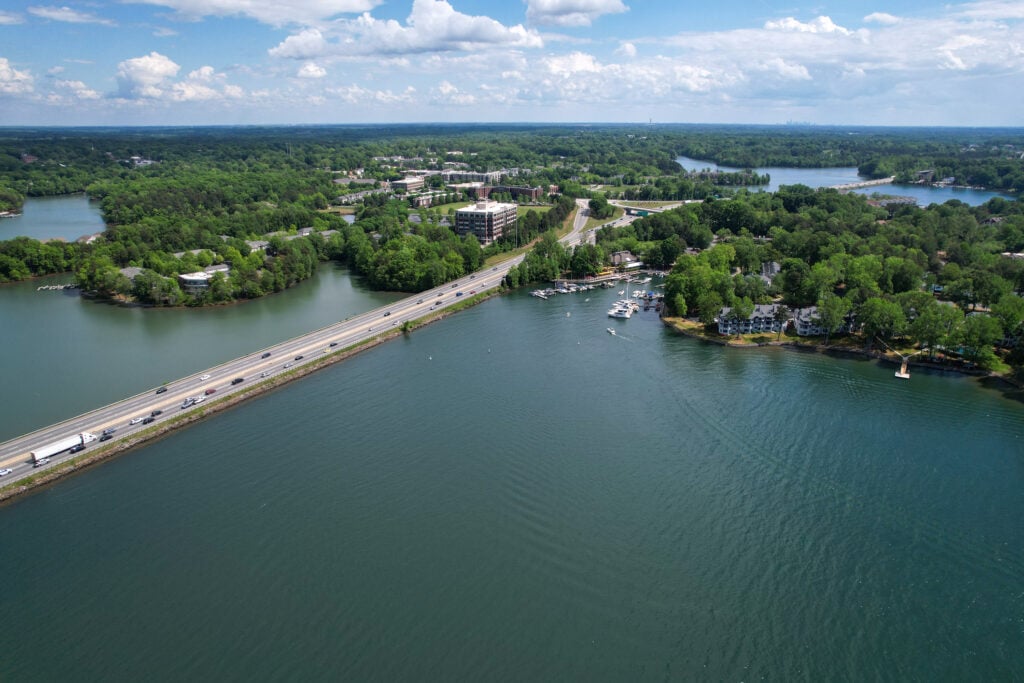
If you’re researching what it’s like living in the Lake Norman area from another city, you’re probably finding the same recycled content everywhere. Best restaurants. Miles of shoreline. “Just 20 minutes from Charlotte!” All true and yet sometimes it isn’t helpful for actually understanding what it’s like to live here.
This is the version you’d get if you were sitting in my car.
First, Forget What You Know About Suburbs
I grew up outside of Atlanta in Lawrenceville, Georgia. And pretty much anywhere in the Atlanta metro, the pattern is the same: you get excited that a new Walmart is being built. Fifteen years later, that Walmart is the old Walmart because the next new Walmart got built 15 miles farther down the road. The houses follow. Everyone chases what’s newest and farthest from the city, and what they leave behind just deteriorates. That original Walmart becomes a Big Lots. The shopping center around it empties out. One town bleeds into the next with no real identity. Just parking lots, big box retailers, and the same vanilla cookie-cutter feeling no matter where you are.
That’s not what it’s like here.
Part of it is geography. Lake Norman is the largest man-made lake in North Carolina, and it defines the area physically. You can’t sprawl endlessly when there’s a lake in the way. That constraint makes land scarcer and prices higher in some cases, but it also means each town has to work with what it has instead of just pushing the development line outward. There’s a natural boundary, and it forces a kind of intentionality that sprawling metros never have to deal with.
The other part is planning. In the 90’s, the towns up here (Huntersville especially) deliberately studied places like suburban Atlanta and said: we’re not doing that. They adopted various new urbanism principles into their planning guidelines. Garages set back from the front of the house. Front porches. Neighborhoods that connect to each other instead of dead-ending in cul-de-sacs. Walkable street networks. It wasn’t just about neighborhood aesthetics, it was about long term planning that shaped how entire communities got built.
The result is something you feel before you can name it. You drive through and think, “this is nice,” but you might not realize it’s because the traffic signals aren’t hanging from wires — they’re mounted on overhanging poles. The crosswalks are brick. There are double sidewalks and bike route signs and landscaped medians with actual trees. These are small, deliberate details, and they’re everywhere.
And here’s the thing that really flips the script from how it works in Atlanta: instead of new areas being built farther out while the old ones decline, the existing areas here tend to level up. A Food Lion becomes a Whole Foods. A modest shopping center gets resurfaced and upgraded. It’s not a perfect pattern, and there are real conversations about affordability and what gets lost when everything moves upscale. But the trajectory is fundamentally different from what I grew up with.
We Talk in Exits
This is the first thing you need to know to understand how locals think about the area.
All of the Lake Norman towns on the east side of the lake line up along I-77, running north from Charlotte. And we identify them by their exit numbers. Not by street names or landmarks, but exits.
Here’s your mental map:
- Exit 19 — It’s where I-485 (the loop around Charlotte) meets I-77. Exit 19 is somewhat of an exception to the “Exit Identifier” as we tend to call this 485. For mental map purposes though, you can think of Exit 19 as the boundary between “Charlotte” and “Lake Norman” in most people’s minds.
- Exit 23 — Huntersville. Novant Hospital, shopping, restaurants, old downtown Huntersville on the east side.
- Exit 25 — The crossover between Huntersville and Cornelius. Birkdale Village. Target/Lowes/Home Depot. The golf course. A mix of large and boutique shopping, restaurants and residential.
- Exit 28 — Cornelius. When you get off here, the overpass is designed to look like a sailboat. That’s your “welcome to the lake” moment.
- Exit 30 — Davidson. College town. Different feel entirely.
- Exits 33, 35, 36 — Mooresville. Multiple exits because the town covers more ground.
- Exit 42 — Troutman. Farther north, more rural, emerging.
The west side of the lake — Denver, Sherrills Ford, Terrell — doesn’t follow the exit framework because those towns are accessed via Highway 16 and other routes. We’ll cover those separately.
When you see a Facebook group called “Exit 28 Ridiculousness” or “Exit 28 is Great,” now you know what they’re talking about. It’s a thing, and nobody can quite explain where it started, but it’s how the area organizes itself.
Think of the exit numbers as approximate mileage markers from the state line. Exit 23 to exit 25 is about two miles. Exit 25 to exit 28 is about three. Each exit has its own feel, its own commercial character, its own residential personality. It’s one of the reasons the towns up here maintain distinct identities instead of blurring together.
The Commute: I-77 and the Toll Lanes
This is the question everyone asks, so let’s just talk about it honestly.
I-77 is the primary north-south artery connecting Lake Norman to Charlotte. If you’re going to Uptown for work, this is your road. From Huntersville (exit 23), you’re looking at roughly 20 minutes without traffic. From Cornelius (exit 28), roughly 25. From Mooresville (exit 33-36), you’re in the 30-40 minute range.
With traffic, it depends on whether you use the toll lanes.
The express lanes run from Mooresville down to Charlotte — two regular lanes (in most sections) and two toll lanes in each direction. The tolls are dynamic, meaning they fluctuate based on real-time demand. On a recent Friday afternoon around 12:49 with some traffic, the sign showed $4.25 for a five-mile stretch. During rush hour, it can go higher. If you have three or more people in the car, it’s free under the HOV exception, and you toggle a switch on your NC Quick Pass transponder to indicate that. You save money using the transponder over the billed by mail rate.
When they first opened, locals call them “Lexus lanes,” and that tells you how people felt about them. Sometimes there can be tension between drivers who can afford to use them daily and those watching from the regular lanes. The express lanes were built by a private company under a toll concession — not publicly funded like the some other parts of Charlotte. With all that is great about the Lake Norman lifestyle, if we are keeping things real, sometimes that disparity feeds a broader sentiment in the Lake Norman area that the northern towns pay significant taxes but don’t receive the same infrastructure investment as the southern part of the metro. It comes up in conversations about roads, schools, transit, and the long-delayed Red Line.
That said — when the toll lanes work, they work. I’ve never sat in traffic while using them. The only tricky part is merging back into regular traffic at your exit. You cross from the toll lane into the regular lane into the exit ramp in a short window, and you’re at the mercy of whether people let you in.
Bottom line: the commute is manageable, especially compared to what you’re probably used to if you’re coming from Atlanta, DC, or the Northeast. But it’s not nothing, and which town you choose will affect it meaningfully.
The Towns
Lake Norman isn’t one place. It’s a collection of towns, each with a distinct personality, and choosing the wrong one is the most expensive mistake a relocating buyer can make. Saving money on a house in a town that doesn’t match your lifestyle means you’ll be restless inside a year.
Here’s the quick framework, and each town has its own deep-dive page:
Huntersville — Closest to Charlotte. Best commute math. Strong new urbanism planning. Not really on the lake, but fully in the Lake Norman ecosystem. Best for people who want proximity to the city with a distinct suburban identity.
Cornelius — The heart of lake-area living on the east side. Where the sailboat bridge welcomes you. Walkable infrastructure, brick crosswalks, nine banks in a one-mile stretch that tells you something about the wealth concentration here. Best for people who want to feel like they live in a real lake town without sacrificing convenience.
Davidson — College town anchored by Davidson College. Walkable downtown, strong identity, fiercely protective of its character. A different vibe from everywhere else on the lake. Best for people who value a sense of community and are ok with driving to Huntersville or Mooresville for a Target run.
Mooresville — More geographic spread, more price range, a charming downtown that’s evolving. Mooresville Graded School District serves most of the east side of Mooresville and while Iredell Statesville School District serves the west. Best for families who want convenient shopping and more housing options.
Denver / West Side of the Lake — Highway 16 access, Lincoln County taxes (generally lower). The west side is growing and you will find remnants of what feels “Old School Lake Norman” combined with modern shopping and restaurants but without the distinct identity of the east side towns. Best for people who want space, value, and don’t need to be close to the I-77 corridor.
Sherrills Ford / Terrell / Troutman (Northwest of Lake) Similar to Denver, these communities sit North of Denver and West of Mooresville. This area is also growing quickly and is best for people who are willing to drive a little farther for the convenience for a little more land and affordability.
Each of those pages will tell you the story of the town — not just the data, but how it actually feels and who tends to be happiest there. Start with whichever one sounds closest to what matters to you.
About This Guide
I’m Kay Fisher, co-owner of KB Fisher & Co. I’ve lived in the Lake Norman area since 2000. I interned for a homebuilder here when exit 23 was a dirt lot, sold new construction through the housing boom and bust, and have spent 25-plus years watching these towns grow from quiet lake communities into the place everyone seems to be moving to.
This guide exists because most relocation content is written by people who’ve never had to explain to a buyer from Roswell, Georgia why Cornelius isn’t Alpharetta, or talk an engineer from Northern Virginia through the CMS school assignment process, or help someone from Chicago understand that “20 minutes to Charlotte” means something different at 5:15 on a Tuesday.
If you’re relocating and trying to figure out where you’d actually be happy, not just where the data says you should look, that’s the conversation we’re here for.
Not sure which Lake Norman town is right for you? We’ve helped families relocate from Atlanta, DC, New York, and across the country find the right fit. It starts with a conversation, not a search filter. [Click here to get started!]
Ready to see what’s available?
Search Homes