
Over the last few years, I’ve spent a lot of time listening- to clients, to agents, to economists, to headlines, and to the numbers behind them. And while the housing market was incredibly active, it didn’t feel grounded. It felt distorted.
I’ve been doing this a long time, and there were moments between 2021 and 2023 when the market didn’t resemble anything we’d experienced before. We were FaceTiming showings because buyers couldn’t get there fast enough. We saw sellers go under contract with $60k non-refundable deposits from out-of-state buyers who wouldn’t even see their home until closing. Even when it was exciting to be a seller, it was an incredibly stressful time to buy — and it wasn’t exactly healthy for anyone.
When I was a new home sales rep, the builder would run sales contests. Sales contest season was always the best time to buy — especially toward the end, when hitting numbers meant company trips and bonuses for management. One of my sales managers used to tell us that buyers needed to “condense their decision-making time.” He meant: take everything you’d normally think through over a few days, and really focus on it over the course of an hour so you could move quickly on a good opportunity.
2021 to 2023 felt a little like that — except many buyers didn’t even have the space to condense decisions. They had to skim them. Fast, in a way that didn’t leave much room to think.
Brian Buffini leads the largest real estate coaching and training company in North America, Buffini & Company. I always make a point to watch his Bold Predictions because, year after year, they tend to land right on target. This year he repeatedly used one word to describe the last market cycle: artificial.
That word stuck. Because it explains why so many people still feel unsettled.
What we lived through wasn’t a normal up-and-down housing cycle. It was a market shaped by emergency-level interest rates, stimulus money, sudden lifestyle shifts, historically low inventory, and a massive wave of remote work — all happening at once.
That combination didn’t just move prices. It rewired expectations.
Why the 2021–2023 Housing Market Didn’t Feel Normal
In a healthy housing market, preparation, timing, strategy, and good advice tend to pay off over time.
In that artificial market, urgency ruled.
The Artificial Housing Market: What Actually Happened
Speed beat reflection. Speed beat positioning. Speed beat long-term thinking.
You probably felt it. If you waited 24 hours, the house was gone. If you asked too many questions, someone else didn’t. If you hesitated, you lost. And honestly, that pace wasn’t sustainable for anyone.
For 2026, Buffini talks about the market “returning to the rhythm of 2019.” He isn’t saying we’re going backward. He’s describing a return to a functional environment — one where inventory exists, time exists, and the process makes room again for evaluation, negotiation, and real planning.
And that shift is already showing up locally.
The Housing Market Shift: Returning to a Healthier Rhythm in 2026
Two years ago, almost every conversation I had centered on speed: “How fast do I need to move?” “How much over asking?” “Should we waive everything?”
Recently, the questions sound different: “What does normal look like again?” “How long are homes really taking to sell?” “What’s actually happening in our local market?”
This is where the conversation stops being theoretical and starts sounding like what you may already be seeing in your own neighborhood.
What This Shift Looks Like in the Charlotte Metro Housing Market
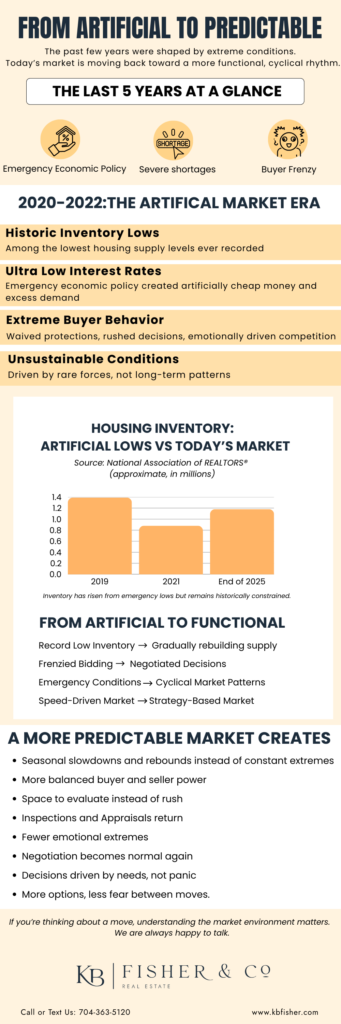
In December 2021, our local months of housing supply sat around 1.4 months. That’s extreme scarcity. By December 2025, it had moved to roughly 3.7 months. That doesn’t mean oversupply. It means choice.
Choice changes behavior. It changes tone. It changes how people show up to the process.
Charlotte and Lake Norman Market Data: What the Numbers Tell Us
Days on market tell the same story. Back in December 2021, homes in the Charlotte area were averaging around 25 days. By December 2025, that number was closer to 51.
More time on market doesn’t automatically mean something is “wrong.” It means buyers can breathe. It means sellers actually have to think about pricing, condition, and presentation again. It means decisions are being made with information instead of adrenaline.
Even pricing behavior reflects the shift. In December 2021, homes were selling at essentially 100% of list price. By December 2025, that number was closer to 95.4%. We’re back in real conversations again — inspections, repair requests, strategic pricing, actual negotiations.
What I’m Seeing Across Charlotte and Lake Norman Neighborhoods
I see it weekly now. In neighborhoods around Lake Norman where homes would have had ten offers in a weekend a few years ago, we’re often seeing two or three serious buyers over a couple of weeks. Instead of waiving inspections, most of my buyers are keeping them in and using that time to truly understand the property.
A more predictable market gives people their agency back. Buyers don’t feel like they’re gambling. Sellers don’t feel like they’re throwing a dart. Moves can line up with school calendars, job changes, aging parents, or financial planning instead of panic.
From Urgency to Clarity: How the Real Estate Process is Changing
I’ve felt the difference in conversations this year. They’re calmer. More thoughtful. Less about “Can we win?” and more about “Is this right?” People have time to talk through trade-offs instead of just asking, “How do we beat everyone else?”
Why This Type of Market is Better for Families and Communities
In that artificial phase, urgency was everything. In this more predictable season, clarity matters again. You deserve the time to get clear about your goals, your budget, your timing, and your local market.
This environment favors sellers who understand what’s actually happening in their specific area — not what went viral last year. It supports buyers who want to choose well, not just compete. It creates space for good representation to matter again. Pricing, preparation, marketing, and honest guidance start carrying real weight.
Most people, if they’re honest, would rather move in a market like this — even if it doesn’t generate dramatic headlines.
Will Multiple Offers Ever Happen Again?
Not entirely. Even at the peak of the housing crisis, when there was nearly 18 months of inventory, the best-priced, best-presented homes still created multiple-offer situations. I don’t think that will ever change.
In my experience, multiple offers are a strategy game. They work well for some situations — and not for all.
Buffini’s framing resonated with me because it resets expectations. It gives language to something people have already felt: that the last few years weren’t “normal,” and that it’s okay if this season looks different.
What This Means if You’re Navigating the Charlotte Housing Market in 2026
If you’re thinking about a move this year, the most useful conversations right now aren’t about timing a frenzy. They’re about understanding your specific neighborhood, your price band, and what this market actually means for your plans.
In a future post, I’ll dig into what national economists are projecting and how that data lines up with what we’re seeing on the ground here. This one is simpler. It’s about what you’re already noticing — and what the local numbers are quietly confirming.
The artificial phase is fading. In its place, a more familiar rhythm is returning.
And if you want to talk through what that means for your specific situation: your neighborhood, your price point, your timeline- I’m always happy to walk through it with you.
Ready to see what’s available?
Search Homes